

News
Swiss Young Academy SYA

News
Introducing Compassionate Science: how empathy and compassion are reshaping research
Scientific research traditionally relies on objectivity, methodological rigor, and measurable outputs. Yet a growing body of scholarship recognises that these values need not come at the expense of relationships, ethical responsibility, and attentiveness to the people and communities that research aims to serve. “Compassionate Science” was developed to address this gap, and to encourage reflection on how compassion can be meaningfully embedded in research practice, whatever the discipline. We are delighted to announce the publication of our “Compassionate Science” report and the corresponding interview series, exploring how empathy and compassion shape research practice across disciplines.
Swiss Young Academy SYA

Blog
Bridging research and practice
He brings together people from within and beyond academia – with the aim of helping us respond more effectively to climate change. Benjamin Hofmann is a researcher at ETH Zurich’s TdLab. As a member of the Swiss Young Academy, teaching is particularly important to him.
Swiss Young Academy SYA

News
Call for Submissions: Teaching Tools for Bridging Science and Societal Partners
Following the workshop "Teaching Tools for Bridging Science and Societal Partners", held on 23 June 2026 in Bern, our “Innovative Teaching” project group in collaboration with network for transdisciplinary research (td-net), invites lecturers and educators to submit concrete teaching tools for an add-on to the td-net toolbox, which contains methods and tools for co-producing knowledge.
Events

5 November 2026
Science@Noon event: Compassionate Science
This edition of Science@Noon is dedicated to the topic of how compassion can become a guiding principle for rigorous and responsible research. The following speakers will present and lead the discussion: Clément Meier (University of Lausanne & JAS); Louise D’Eer (Ghent University); Miriam Zemanova (University of Fribourg)
The event will take place at the House of the Academies in Bern. It is also possible to attend online.
Publications
Swiss Young Academy SYA

Compassionate Science - Integrating Empathy and Compassion in Research
This report explores how empathy and compassion shape research practices across disciplines. Drawing on a review of existing literature and illustrative examples from early-career researchers, it shows that empathy and compassion are not abstract ideals but practical dimensions of research that can influence study design, relationships, data interpretation, and knowledge translation. Across fields, integrating these dimensions can strengthen trust, deepen understanding, improve collaboration, and enhance ethical reflexivity.
Swiss Young Academy SYA
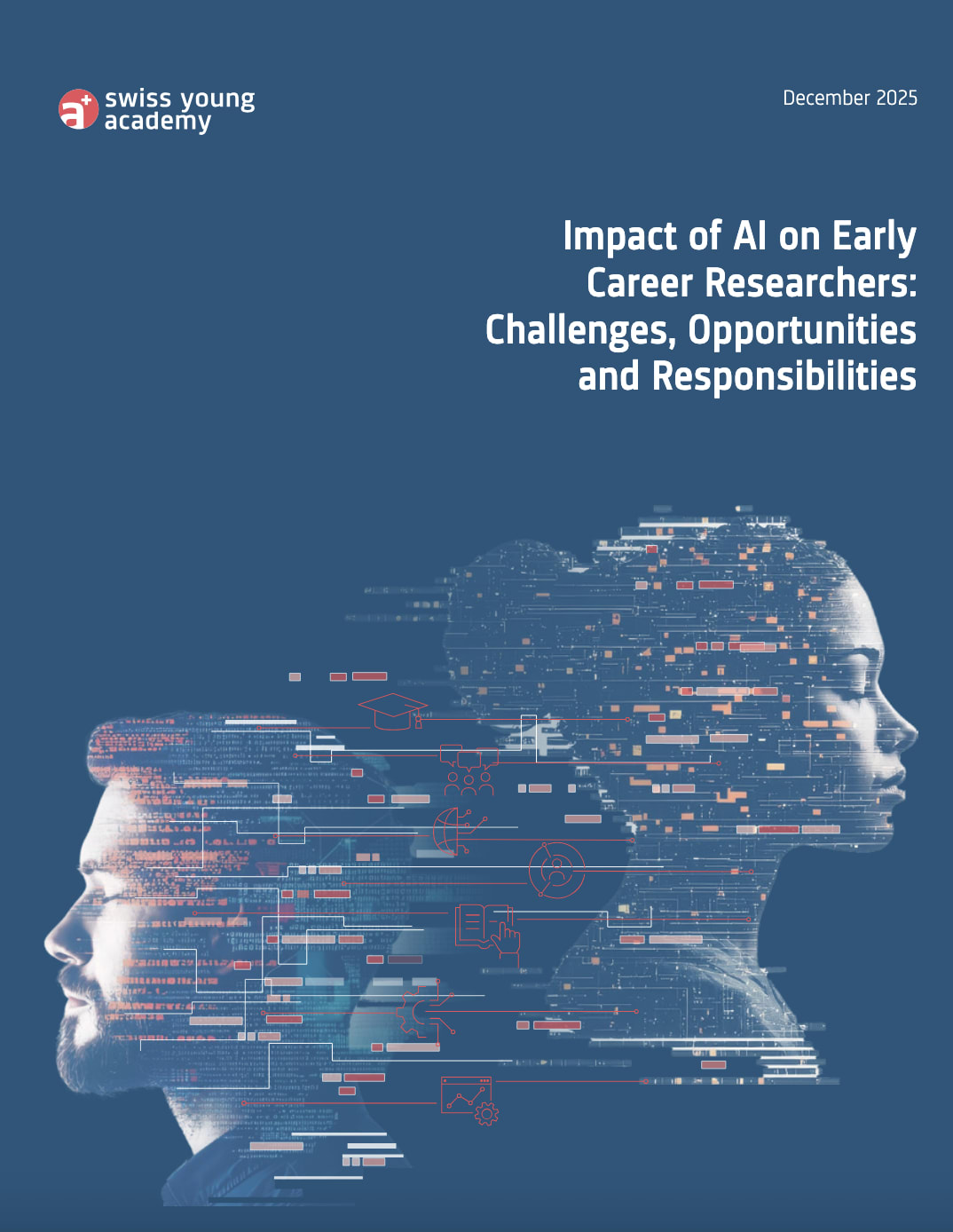
Impact of AI on Early Career Researchers: Challenges, Opportunities and Responsibilities
Artificial Intelligence (AI) is rapidly transforming science and is therefore profoundly reshaping the work of Early Career Researchers. Against this backdrop, the publication Impact of AI on Early Career Researchers: Challenges, Opportunities, and Responsibilities, developed by members of the Swiss Young Academy, namely Emmanuel Senft, Sabrina H. Kessler, Pamela Delgado, Devi Bühler, and Alexandre Bovet, offers a timely interdisciplinary reflection on these changes. The booklet examines both the opportunities and risks of AI across five key areas – research, teaching, science communication, policymaking, and sustainability – while also addressing critical issues such as research integrity, data privacy, misinformation, governance, and environmental impact. It further highlights the responsibilities of Early Career Researchers and higher education institutions in promoting AI literacy, transparency, ethical standards, and responsible use of AI in science.
Swiss Young Academy SYA
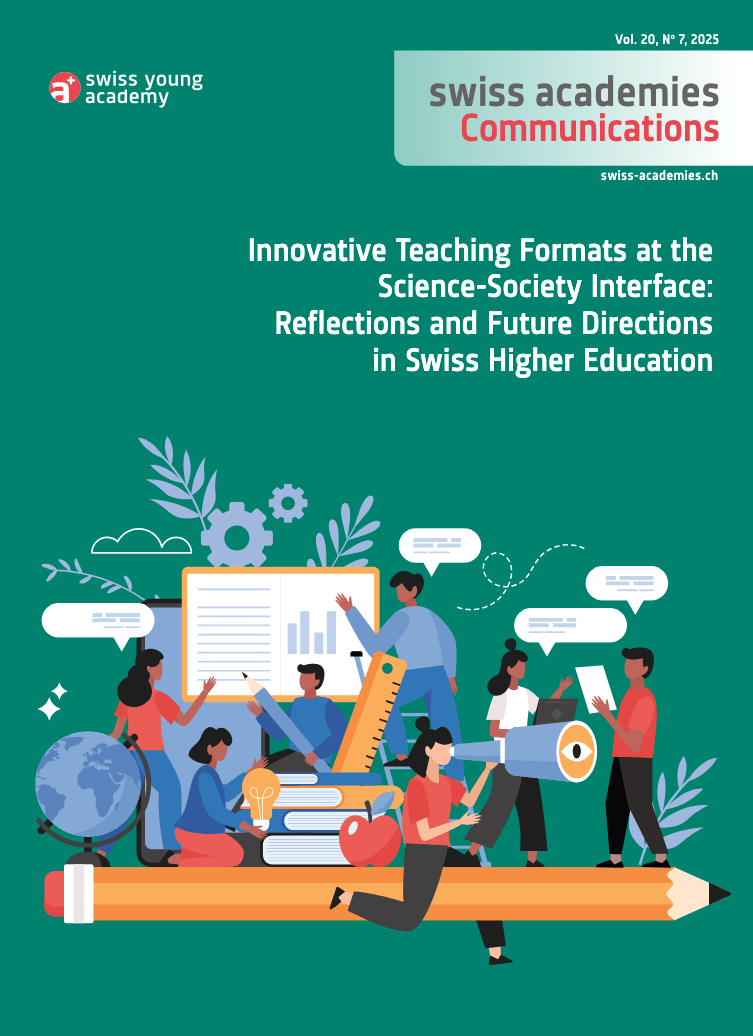
Innovative Teaching Formats at the Science-Society Interface: Reflections and Future Directions in Swiss Higher Education
Science-society dialogue is crucial for addressing pressing societal challenges. One important avenue for strengthening this link, in an inter- and transdisciplinary perspective, is teaching formats that encourage students to engage in the public sphere. However, an illustrative collection of best practices in Swiss higher education has been lacking so far. This practice-driven report draws on a non-exhaustive stocktake of existing courses in Switzerland and participatory workshops among lecturers. It features illustrative examples from Swiss higher education institutions and introduces a new typology of science-society teaching formats, offering educators a structured way to design and analyze courses across six dimensions. In addition, the publication discusses both the opportunities and challenges of implementing such teaching formats. To further advance science-society education, the report identifies three priority areas for action.
Swiss Young Academy SYA
On Science for Policy and Diplomacy Education in Switzerland and Beyond: A Brief Overview
Some of the most pressing challenges worldwide, from global pandemics to the climate and environmental crisis, require efforts at the interface of science, policy, and diplomacy. To this end, skills development for scientists engaged with science for policy and diplomacy is increasingly important, yet relevant educational offers in Switzerland and worldwide remain limited. The Swiss Young Network for Science Policy and Diplomacy, in collaboration with the Geneva Science-Policy Interface and the Franxini Project of Reatch, considered educational offers in science for policy and diplomacy available for early-career academics, including courses, workshops, and webinars in Switzerland, across Europe, and beyond.
Swiss Young Academy SYA

Podcast "Spark - Stories from Advocates for Global Change"
Spark offers young listeners (ages 16–23) an accessible entry point into the world of transdisciplinary research, showcasing how collaboration across different fields of study is essential to solving complex real-world problems. Through engaging storytelling, the podcast highlights how careers in science can take many shapes, offering insights into the diverse paths within this field. By connecting young listeners with the stories behind the research, Spark aims to foster public engagement with science, encourage deeper connections between established experts and young audiences, and inspire greater involvement in global issues.
Swiss Young Academy SYA
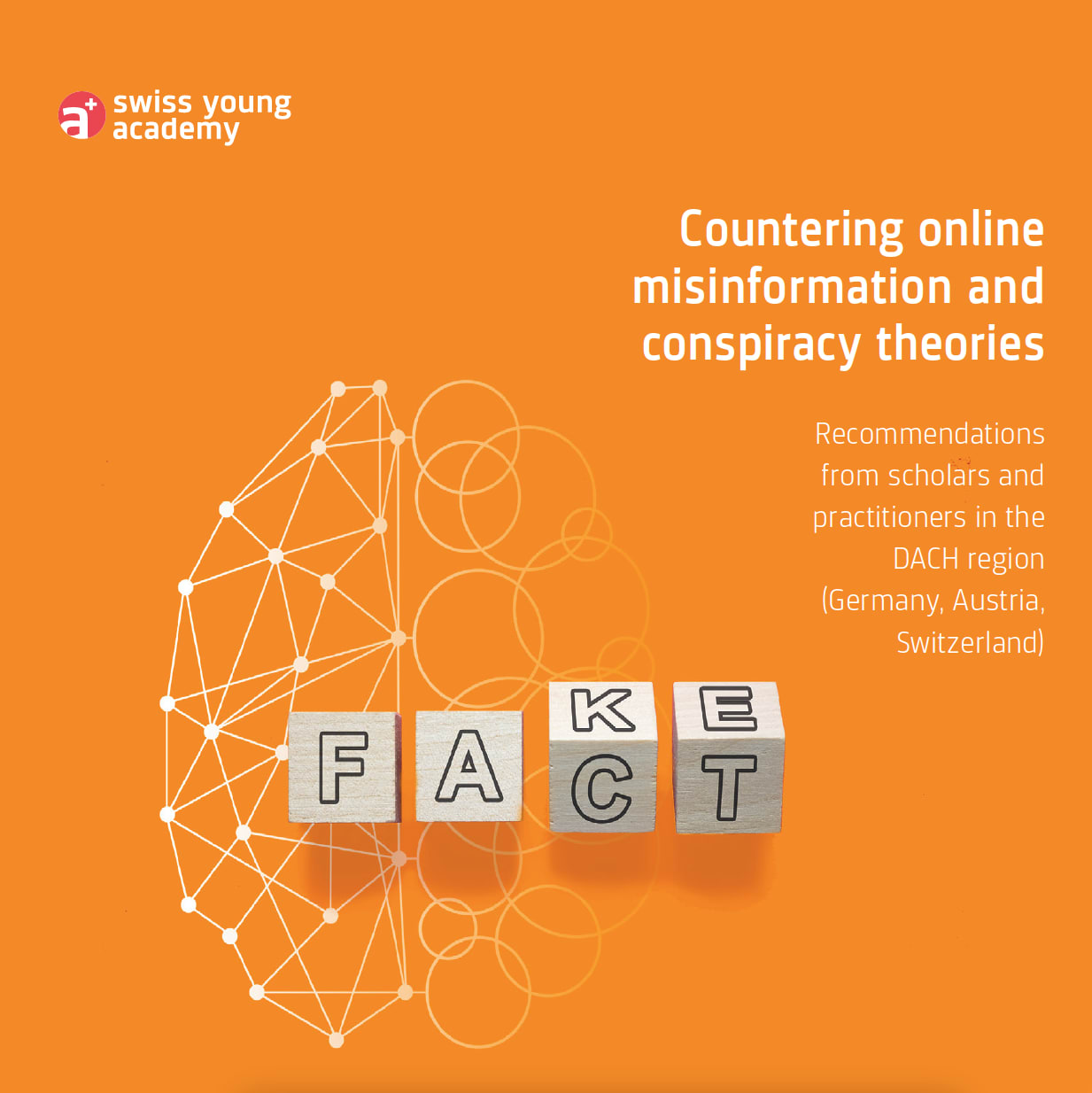
Countering online misinformation and conspiracy theories - Recommendations from scholars and practitioners in the DACH region (Germany, Austria, Switzerland)
Misinformation, half-truths, and conspiracy theories can cause considerable harm to society. Therefore, it is crucial to take effective measures to counter their spread. Researchers from the Swiss Young Academy (SYA) and the University of Zurich have decided to tackle this challenge head-on. In a three-wave Delphi study scholars and practitioners from 13 countries were asked to identify current challenges in responding to online misinformation and conspiracy theories, to predict developments in this area, and to use these findings to develop targeted measures that respond to the challenges. The recommendations presented in this flyer are specifically aimed at the DACH region and are intended to support decision-makers in politics, technology platforms, journalism, academia, and other fields.
Swiss Young Academy SYA

Who gets heard? Scientific experts at the Hearings of Parliamentary Specialist Committees
How do scientific insights find their way into parliament? Researchers in Switzerland often do not have a clear answer to this question. A new publication by the Swiss Young Academy provides practical tips, insights and background information on the legislative process. This orientation guide is intended to enable (young) scientists to successfully contribute their knowledge to parliamentary deliberations.
